
Human Factors Engineering
Ready for Takeoff
Elevating Participant Training in Usability Studies
When planning participant training prior to a usability study, Emily Alexander uses pilot training as an analogy. Training participants prior to their session is like preparing student pilots for their first solo flight. Every aspect of the pilot training process is intentional, structured, and consistent to ensure safety during every flight; training of users, and participants during usability studies, should operate the same way to ensure all users are set up for success.
Fathom is a business and design consulting firm located in Minneapolis, MN. We’re research-driven. Relentlessly collaborative. Flexible by nature. And we’re committed to providing practical, implementable solutions for your toughest business challenges—solutions informed by the people who will be most affected by them.
Training to prepare for real-life situations
There are several reasons that training may be needed for users of a new medical device. Perhaps the device is so novel that users need an introduction prior to use. Maybe the device is similar to existing devices and training is a way to correct existing mental models that users may have. Or, perhaps, the risk associated with use is high for a particular workflow and training can help mitigate risk. No matter the reason for training, there are some things to keep in mind to make sure it is effective for both human factors summative studies but also during commercialization.
Let’s explore the topic of training via an analogy of pilots being trained to fly a plane. Pilot training is developed to prepare for real-life situations, not to pass the test for a pilot’s license. Similarly, the first key to success when developing training is to think about what training will be when the device is commercialized, not what training should be like for the upcoming human factors study. This ensures training is the most realistic and representative, eliminating the need for justifications if training differs between a study and commercialization later on. It can also help ensure the scope of training is manageable and avoids adding burden to the company when they are ready to sell the device to users.
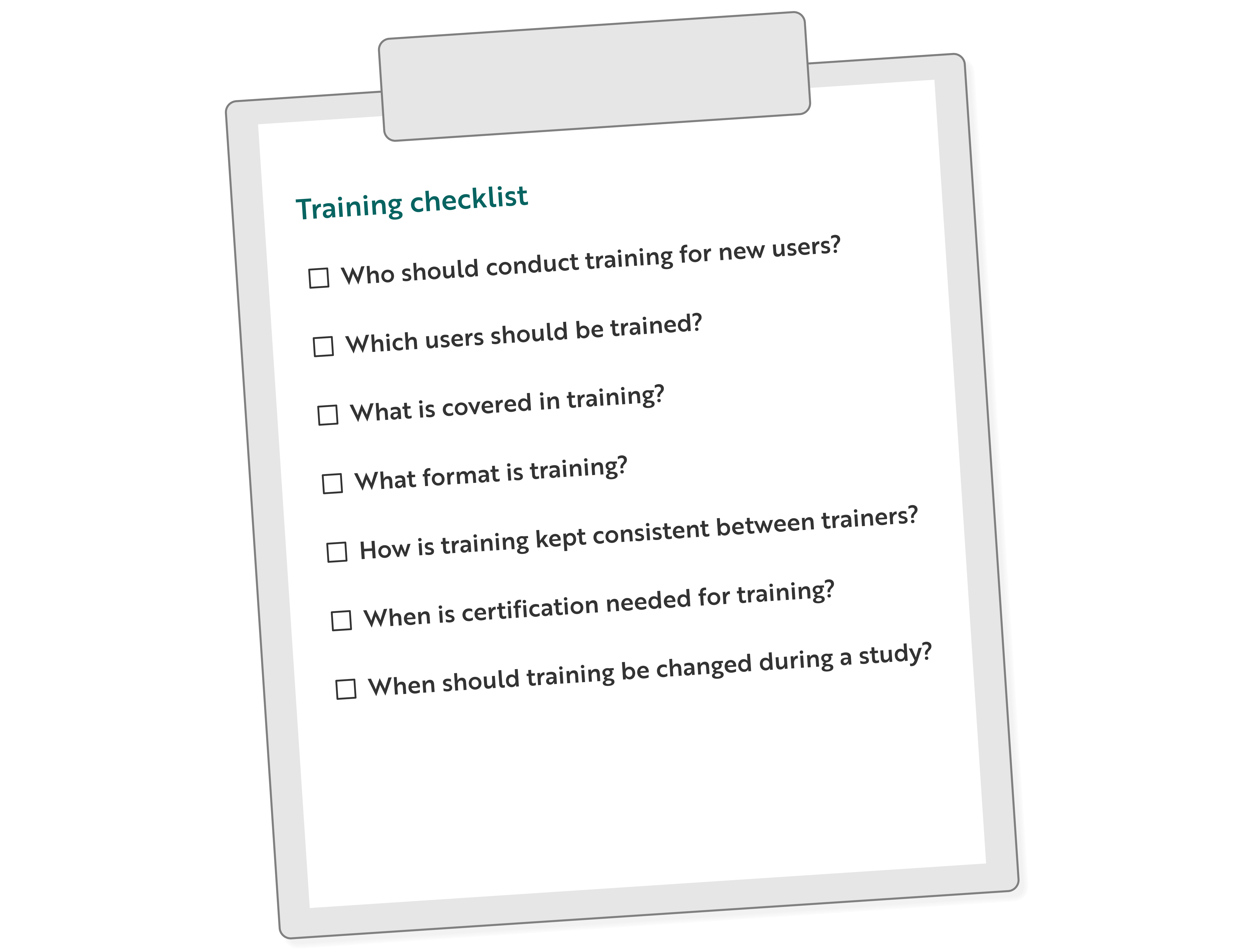
Who should conduct training for new users?
A mechanic, while intimately familiar with certain parts of the plane and their function, would never train a pilot to fly. A mechanic has a different vocabulary and typical set of interactions with the plane than a pilot.
Similarly, engineers or other design team members aren’t ideal trainers as they may lack the clinical vocabulary and experience to accurately communicate concepts. While members of the design team might conduct training of participants in formative studies when training is still being developed and use of the device is being explored, clinical trainers or marketing team members, who will conduct training for real-life users, are more ideal to train participants in summative studies. Training should be created as a joint effort between the engineering and training teams to ensure important design aspects, as well as clinical aspects, are included and thoroughly explained to prospective users.
Which users should be trained?
Our plane example provides a couple different user types: pilots and cabin crew. The tasks that pilots are responsible for in the cockpit are unlikely to require training for cabin crew members. Likewise, cabin crew tasks, such as securing cabin doors, might be something pilots are aware of but not actively performing on a regular basis.
The first step in determining which users need training is to evaluate the tasks per user group. Consider a device used in the operating room and who may interact with that device during a procedure. The tasks may be broken down into set up led by a circulating nurse, procedure use completed by a surgeon, and teardown and disposal done by the circulating nurse.
Consider what is unique about the tasks for each user group and how they might compare to standard procedures or other devices that user is often interacting with in their role. Steps such as opening packaging and disposal are unlikely to be unique compared to similar devices and may not require training to be able to complete successfully.
What is covered in training?
Flight school courses cover all aspects of flying a plane, but emphasis is rightly placed on the most life-threatening tasks. Similarly, it’s important to provide a high-level overview of device use to help orient the trainee before diving into specifics. Consider high-risk or critical tasks per the device’s risk documentation. These high-risk tasks should be a training focus area, especially if the task has no other mitigations.
When determining what to include in training, it can be helpful to keep in mind the amount of time available to train users. It can be tempting to include information about every aspect, but the longer training lasts, the higher the potential for overwhelming users. Prioritizing the most vital information will set users up for success.
Sometimes training takes a while. Maybe it’s a multi-day process or requires multiple visits to complete. This may be necessary when real users are preparing to interact with a device, but it may not be feasible for training associated with a summative. Training during a study may need to be condensed due to time limits, budget constraints, low recruitment due to time commitment, or numerous other situations. If training is being trimmed down to accommodate a study, make sure to include a justification as to why it’s still representative.
For more guidance on what to include in training, refer to HE75:2025.

What format is training?
Flight training includes classroom instruction, simulator practice and actual flight time. Similarly, presentations, demonstrations, and hands-on use may be appropriate methods of training for device users, depending on the tasks and information that needs to be communicated. Another thing to consider when choosing a training format is what the user already knows. What experience and knowledge do they already have about the procedure, the device type, and the tasks that need to be carried out. If users have relevant existing knowledge, a presentation may be able to cover the necessary training content and if users are new to the mental models required to interact with a device, hands-on use may be better option.
As a reminder, the training method should be representative of the training method to be utilized once the device is commercialized. If training real-life users will follow a presentation method, human factors summative participants should not receive a hands-on use of the device for their training as this may be perceived as influencing study results.
How is training kept consistent between trainers?
Flight school instructors have a lot to teach future pilots. If they had to teach strictly from memory, training would undoubtedly be inconsistent.
Imagine if the instructor failed to cover information about how to use a plane’s landing gear. The students missing this instruction would face a risky challenge when it came to land a real plane. Now, imagine the situation with a device used in the operating room. If the trainer doesn’t cover all the necessary content, the patient is at risk.
It is recommended that an outline be created that a trainer can follow. This outline should include the minimum content to be covered in an intentional order. It’s unlikely that every user of a device is trained by a single trainer so an outline helps keep content consistent between trainers while still allowing flexibility for individual training style that a detailed script might prevent.

When is certification needed for training?
A certification process is a method to prevent unprepared users from using the device in real life, similar to pilots who must pass their licensing exam prior to their first solo flight. If there are tasks that a user must prove they can do successfully before being allowed to use the device on a real patient, training certification may be helpful. Certification can take many forms but the most common are a trainer signing off on training attendance, a knowledge comprehension test, or a skills-based exam.
There are pros and cons to adding a certification process to a training program. In a human factors summative, a certification process can be used to disqualify a participant who would require additional training. However, adding a training certification process may require more paperwork and coordination by the training team so this workflow should be explored and confirmed prior to summative to confirm it will be used in commercialization.
When should training be changed during a study?
Imagine the next class of flight school students who are ready to take their final exam. The first few students go through their exam and a trend appears where they all experience difficulty with tasks during takeoff. The instructors start providing additional instruction before the next students head into the exam.
A similar scenario occurs when trainers during a human factors summative study observe study sessions or have access to study results. Too often, a single use error results in tweaks to the training plan and the training between the first and last participant are not consistent. Worse yet, these tweaks may not be documented as study deviations or changes to the training meaning the additions might not make their way to users once the device is approved.
Changing or adding content to training mid-study should be avoided when possible. If a use error trend appears during the study that must be addressed via training, it indicates the training was not properly developed or thoroughly tested prior to the summative study. Including training in studies prior to summative is a great way to prevent this.

Conclusion
As in flight school, medical device user training is ultimately about preparing participants for the situations they may face in the field so they can be successful. While no training can anticipate all possible situations, being intentional about our choices ensure participants' best chance for success. By following these best practices, your training will ensure participants are ready for takeoff.
About Emily Alexander
Emily Alexander is a Human Factors Engineer at Fathom Consulting. With over ten years of experience in the medical device industry, she has led the usability testing efforts for numerous devices. She has been part of 850+ individual study sessions and her work has resulted in successful FDA approvals of 22 products and counting. Emily is most passionate about how study design and moderation impacts reporting and analysis of residual risk.
Emily is the Founder and President of the HFES Twin Cities Chapter as well as a Co-Track Chair for the HFES Healthcare Symposium, Medical and Drug Delivery Devices track for 2026.
