
In the kickoff to this series, we shared some observations on how our clients are being impacted by a rapid pace and volume of change, coupled with mounting pressure to not only move faster but also “get it right” on the first try.
In our second piece, we previewed some ideas we’ve been testing to respond to that pressure by evolving our traditional human-centered methods (like the Double Diamond).
However teams decide to adapt, one thing that will remain is the need to listen to and learn from humans: the real people who use, might use, or have used your product or service.
Whether you call it User Needs Discovery, Generative User Interviewing, Field Studies, or Up-Front Research, the best products are grounded in authentic user problems and needs.
Why take a new approach to discovery?
In the Double Diamond model, this kind of discovery centers on broadly exploring a problem the business believes its product could solve. When executed well, this discovery phase also allows the product team to:
- Build empathy for users and remember there is not one generic, perfect user.
- Understand the real-life context in which people are using their product.
- Learn about user workarounds to shortcomings with the current product.
Traditionally, this work has relied on meeting a bunch of users representing each of the product’s key personas in one-on-one sessions designed to observe or interview them. Maybe they were even asked to do a diary study or participate in problem-space definition activities crafted by the team.
The process often blossoms into a larger and longer lift as research teams decide on profiles, craft bespoke research objectives and scripts with the product team, conduct the interviews, and then synthesize what they saw and heard from all those interactions into a big old findings deck. Today, though, by the time those findings are shared, things could have changed in the market, the business, or the budget.
We believe there are still times when a robust problem-focused discovery phase is the right thing to do. Developing deeper empathy and uncovering surprising insights will always help teams better address the needs of their users and customers.
Even so, for the reasons listed above, we are seeing many product teams skip or abbreviate this process and instead move straight to building their strongest hypotheses. That trend got us thinking about alternative paths that could provide valid user input and prove helpful to product teams while remaining practical for their current pace of work.
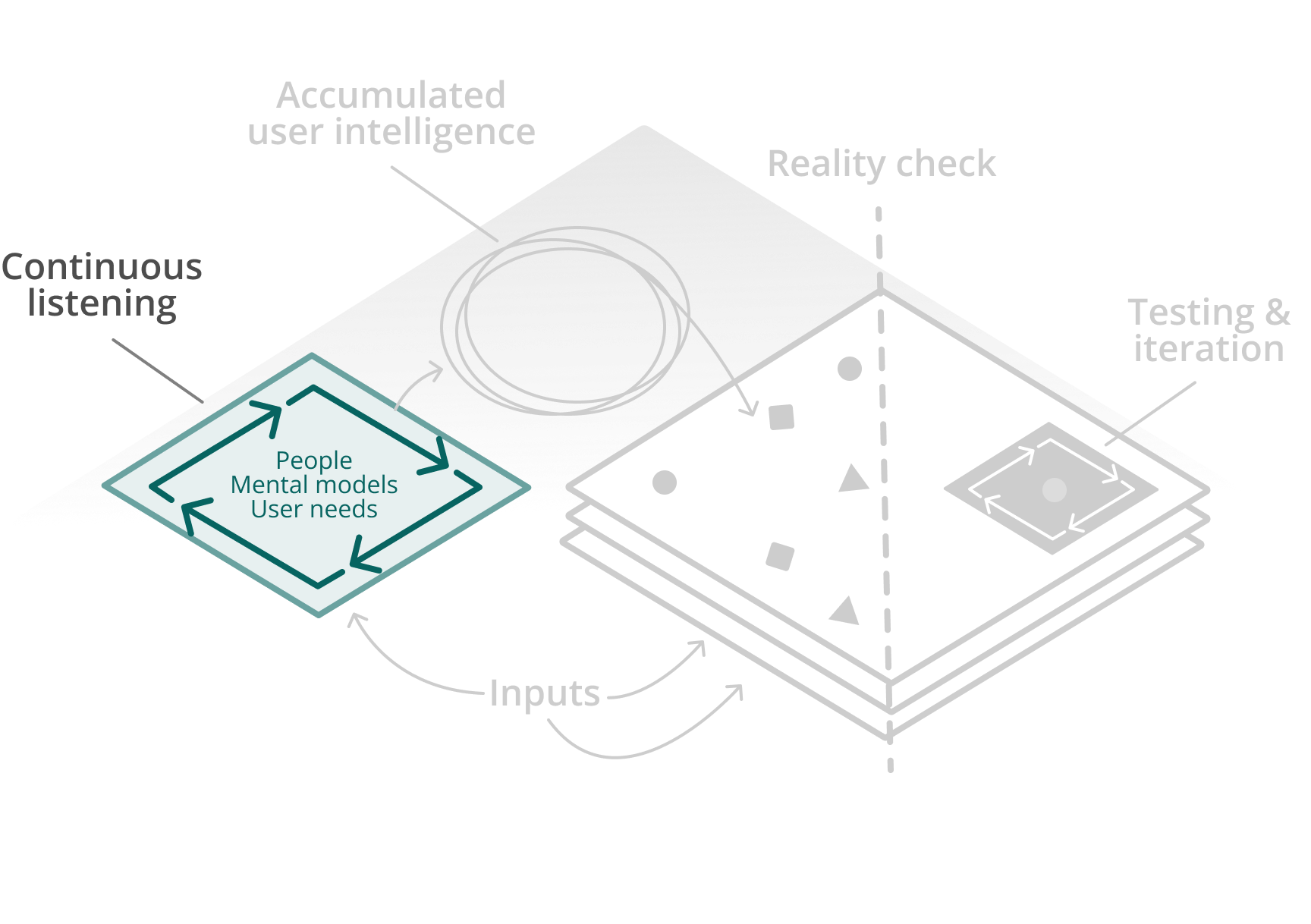
Continuous listening can reduce some of the barriers to talking with users
Imagine if, instead of proposing a 16- to 20-week research project requiring copious stakeholder input—right when your product team is trying to get a new initiative off the ground—you could use 30 minutes of the project kickoff to clearly and succinctly tell them everything you already know about users, their context, and their needs.
This wish led the Fathom team to start experimenting with unscripted, participant-led listening sessions 8 to 12 times a month, all year long. So far, the results have been encouraging.
By continually speaking with users and building a body of knowledge of authentic user behavior and unmet needs, research teams can provide human-centered input at any time to jumpstart product efforts—and offer a reality check on potential solutions (more on that later).
Why continuous listening feels faster
Beyond providing more responsive user input, continuous listening widens the aperture while reducing friction and overhead for other teams and stakeholders.
- It isn’t contingent on stakeholders making time to give input on the script or prioritize between research objectives, so it can be conducted independently and in the background of other product-focused efforts.
- It’s small enough that it doesn’t require researchers to drop everything else for a quarter; it’s a level of effort the team (even a team of one) can usually just absorb.
- It's not pinned to one specific moment in time or one problem space; it’s continuously refreshed and contains answers to all kinds of questions product teams might one day think to ask.
Open-ended discovery focuses on humans, not your product
As human-centered researchers, one of our favorite things about this method is that it centers your time with users on the things they think are important, rather than bringing in a list of hypothesized use cases through a business lens. This allows surprises to come up—things nobody on the team knew users cared about or thought about, things they were trying to do, experiences they were avoiding.
In our ongoing healthcare-focused project, the “script” we created was as simple as can be: “Tell me about a time you recently had to make a decision about your health. What was the situation and how did you approach it?”
From this one question, we could usually listen for about 45 to 60 minutes with only minimal prompting (e.g., “You mentioned asking your aunt what supplements she took. Can you take me back to that moment?”).
The interviews we conducted in this manner felt incredibly “human” and flowed naturally from topic to topic. Participants spontaneously told us that they felt heard, valued, and connected to us, rather than “data-mined” or “tapped out.” Our notes contained a mix of participants’ thought patterns, emotions, values, beliefs, and, yes, interactions with products.
With a continuous discovery approach, not only did our insights become clearer and better validated, but we also started to gain a gut-level feel for our users’ needs and the likely barriers they would face in meeting them. This clarity made generating on-the-fly, responsive insights feel faster, simpler, and truer to the human-centered approach we think results in better products.
A note about related thinking
The methods detailed here weren’t created in a vacuum! The things we tried drew inspiration from and built upon methods put forth by Erika Flowers, Jared Spool, Teresa Torres, and Indi Young, among others.
Stay tuned for more
In our next piece, we’ll look at how to move from continuous listening to generating insights and making them quick to access.
Follow us on LinkedIn to read along and see the results of our ongoing research with healthcare consumers.
