
In our kickoff post for this series, we shared a set of observations that have been resonating with many of our clients: Across industries, teams are facing an unrelenting pace of change paired with mounting pressure to “move fast and get it right” as they work to launch products faster with what feels like less permission to fail than ever before.
In response to these dynamics, we’ve been asking ourselves: Can traditional design thinking methods (like the Double Diamond) evolve to be more responsive, adaptable, and—yes—faster, while staying human-centered?
After many conversations, whiteboarding sessions, and creative workshopping, we believe the answer is yes, and we have some ideas on how. For now, we’re calling our new set of ideas “Adaptive Human-Centered Design.”
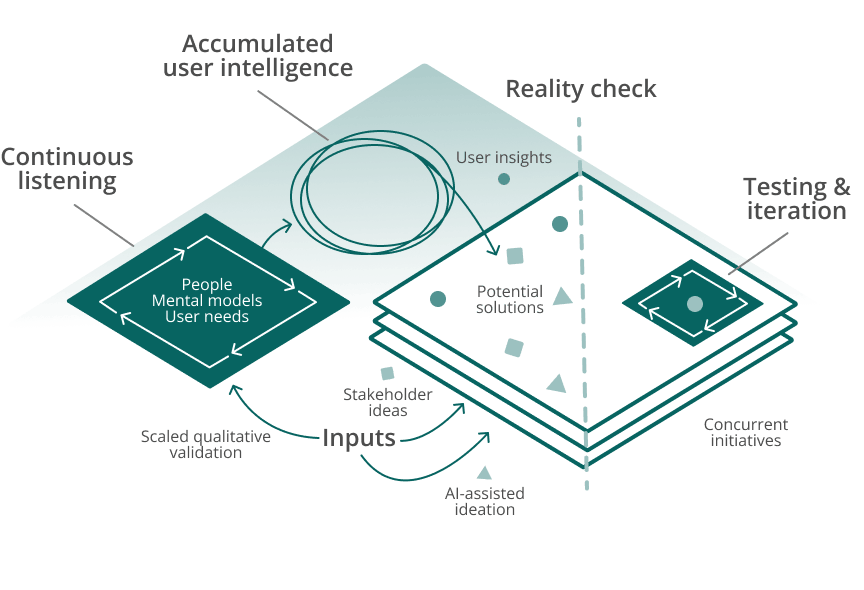
This evolution sets out to address the reasons traditional design thinking is frequently skipped over or stripped back by businesses today. It also aims to shorten the time to uncover and validate user needs without sacrificing input from real humans who use—or could use—your product. Finally, if our experimentation is any indication, this approach should make for stronger ideas that can be validated more quickly and are easier to share with stakeholders as opportunities continue to shift.
While we will cover each feature of this proposed model in depth throughout this series, this article serves as a high-level introduction of the distinct components of Adaptive Human-Centered Design:
- Continuous, open-ended listening and observation rather than a discrete, per-project discovery phase
- Scaled qualitative user needs validation that accelerates the definition phase by leveraging new tools and technology
- Evolved ideation processes combining human creativity and generative AI
- Rapid evaluation methods to prioritize new ideas from outside the design thinking process (say, from your business stakeholders)
- Regular and recurring user input and testing cadence to shorten the timeline and reduce overhead as products evolve
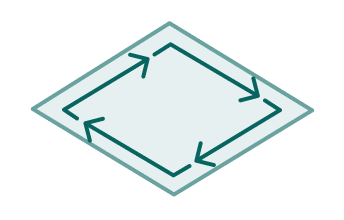
Continuous, open-ended listening and observation
Traditional approaches to writing a research guide, interviewing users, creating user personas, and synthesizing findings can feel like a long runway before you learn anything at all. At times, given the pace of modern design and development, these approaches can produce outputs that feel outdated by the time they’re shared. But understanding users is still critical to making good product decisions.
The move to continuous user listening and learning is a macro shift from the traditional Double Diamond. With no discrete start and stop tied to the product build and release cycle, feature funding decisions, or pet projects, continuous listening can offer a more holistic and responsive view of user needs, barriers, and patterns.
By conducting unscripted, participant-led listening sessions a few times a week, all year long, teams can build an authentic, nuanced body of user knowledge that can grow and change over time. Taking this approach can help teams more quickly respond to and influence business and product decisions, without the overhead of a traditional discovery phase.
Scaled qualitative user needs validation
With continuous discovery happening in the background, product teams can jump straight to asking, “What do users need us to solve? What should our priorities be?”
In the past, getting a focused and direct answer to these questions presented a choice:
- A quantitative study to build a robust data set?
- A qualitative study to find instructive stories about your users?
- A multiphase, mixed-method study to try to get both?
With the advent of AI-moderated qualitative interviews, you can now get the best of both worlds, at least to some extent. We’ve recently written about some early success we’ve had working with scaled qual platforms to hear from a large number of users in their own words.

Evolved ideation processes combining human creativity and generative AI
As we move to the second diamond, we are stepping out of continuous learning mode and focusing on activities to generate, evaluate, and design solutions around a specific initiative.
Approaches like continuous discovery and scaled qual can help teams getting a new project or feature off the ground feel ready to jump into solution mode because sufficient discovery has already been done. In other cases, teams may still benefit from a traditional, focused discovery project and definition phase.
We’ve led a lot of brainstorming sessions in our day. It’s one of our favorite things to do. But, as our clients tell us every day, “Calendars are ROUGH.” Taking six weeks to get everyone into a room adds a lot of pressure when the day finally comes. Humans are often self-conscious, and many struggle to shed their negativity bias.
Enter large language models (LLMs). No calendaring issues here. Not to mention endless positivity and the ability to generate a lot of stuff to think over (even if it’s of varying quality).
The truth is, rapid ideation was never meant to be measured by quality or practicality. It’s about lots of ideas. As long as humans are there to prompt, evaluate, make connections, and build off different ideas, LLMs can help teams push their thinking a little faster.

Rapid evaluation methods to prioritize new ideas (a.k.a. a human-centered reality check)
New ideas can spring up anywhere, not only during carefully planned and executed ideation sessions. They come from executives, they come from engineers and hackathons, they come from peeking over a competitor’s shoulder and from field-based employees’ reports from the front lines.
Rather than meeting these new ideas with a resource-intensive, 20-week research project, those who’ve been doing continuous discovery can simply look to their accumulated knowledge to find evidence that supports or casts doubt on each idea, and, if needed, design a quick user test to probe the biggest blind spots.
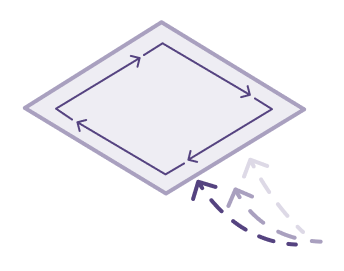
Regular and recurring user input and testing
There’s nothing revolutionary about testing ideas before putting them in the hands of users, but we are trying out some new ways to tighten up this phase as well, including continuous user recruiting to lower overhead, returning to rapid prototyping, and, when appropriate, using asynchronous or unmoderated testing.
We see value in getting back to making the smallest prototype possible to learn what you most need to know, rather than allowing prototypes to get too bloated or double as development-ready designs.
Curious to learn more?
As we share the rest of this series and continue to explore each of these ideas, we’ll be applying our thinking to a real research project about how people make healthcare decisions.
Follow us on LinkedIn to see how it goes, learn more about the specific methodologies we use in each phase, and get the results of our research with healthcare consumers.
Read the full series
- Staying human-centered in the face of rapid change
- Evolving human-centered design: Ideas for a new model
- A case for continuous, open-ended listening
- Moving from continuous listening to insights that get used
